
Introduction
The morning coffee ritual holds a special place in many households. Whether you’re rushing to get ready for work or savoring a quiet moment before the day begins, that first cup sets the tone for everything that follows. Yet brewing coffee often involves making a choice between convenience and quality, speed and satisfaction. Single-serve coffee makers have transformed how many people approach their daily caffeine fix, and they continue to evolve.
The Keurig K-Classic represents one of the more established options in the single-serve coffee market. It’s designed for those who want straightforward functionality without unnecessary complexity. Rather than requiring special equipment, deep coffee knowledge, or lengthy preparation, this brewer promises simplicity: add water, insert a pod, press a button, and within moments, a fresh cup of coffee waits in your mug.
This article explores what the K-Classic actually offers, how it fits into different lifestyles, and what prospective users should realistically expect. Understanding a coffee maker’s capabilities and limitations helps you make an informed decision that aligns with your actual needs and preferences.
What Is the Keurig K-Classic and How Does It Work?
Before diving into specifics, it helps to understand the basic mechanics of this device. The Keurig K-Classic is a single-serve pod-based coffee maker, meaning it brews one cup at a time using pre-packaged coffee pods called K-Cups. These pods contain ground coffee sealed in a small plastic container with a paper filter.
The brewing process is intentionally straightforward. Water is added to the reservoir at the top of the machine. You select your desired brew size using the buttons on the front panel, insert a K-Cup into the designated holder, close the brewer head, and press the brew button. The machine heats the water, forces it through the coffee grounds in the pod, and dispenses the brewed coffee into your cup below. The entire process typically takes between one and three minutes, depending on which brew size you select.
This simplicity is by design. The K-Classic isn’t trying to be a high-tech marvel with dozens of settings and programmable features. Instead, it prioritizes ease of use and reliability—qualities that appeal to busy households and anyone who values consistency without complication.
Key Features and Specifications
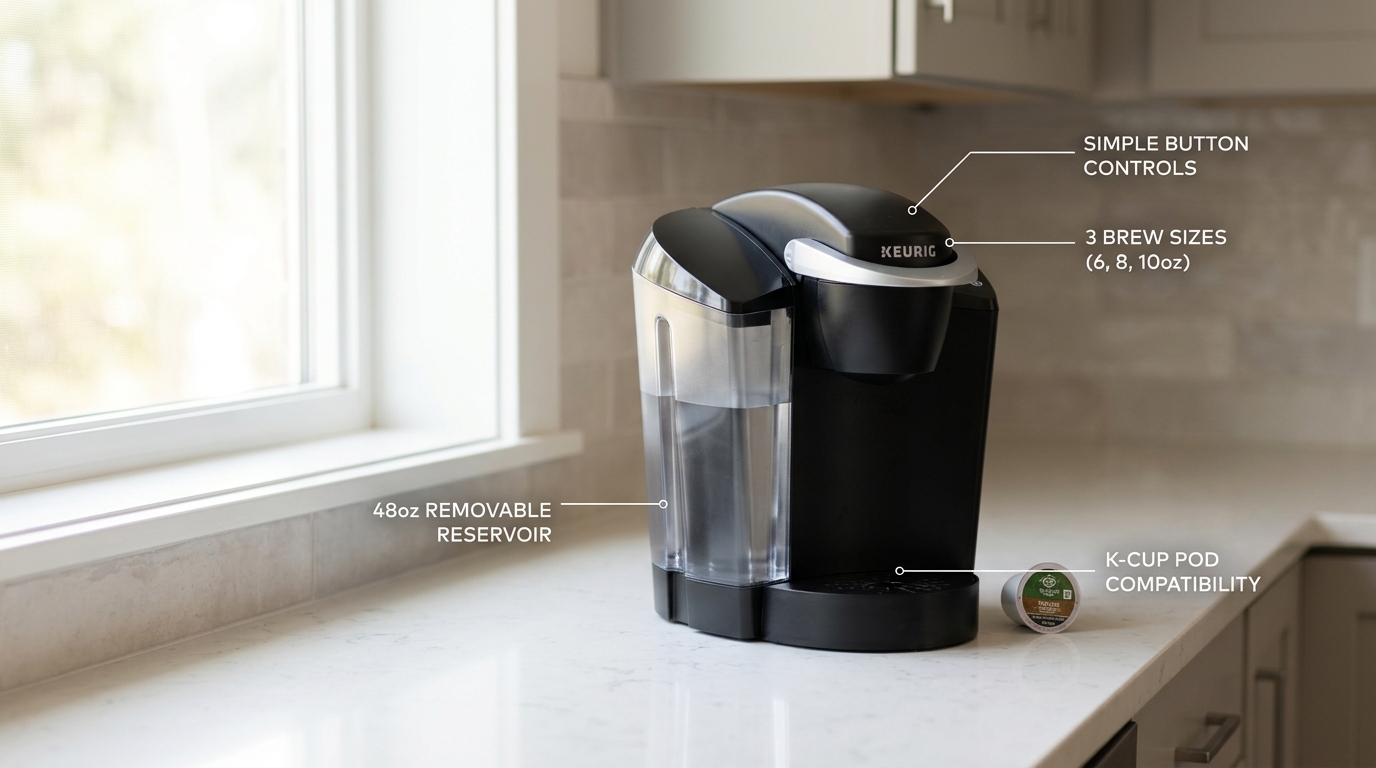
The Removable 48-Ounce Reservoir
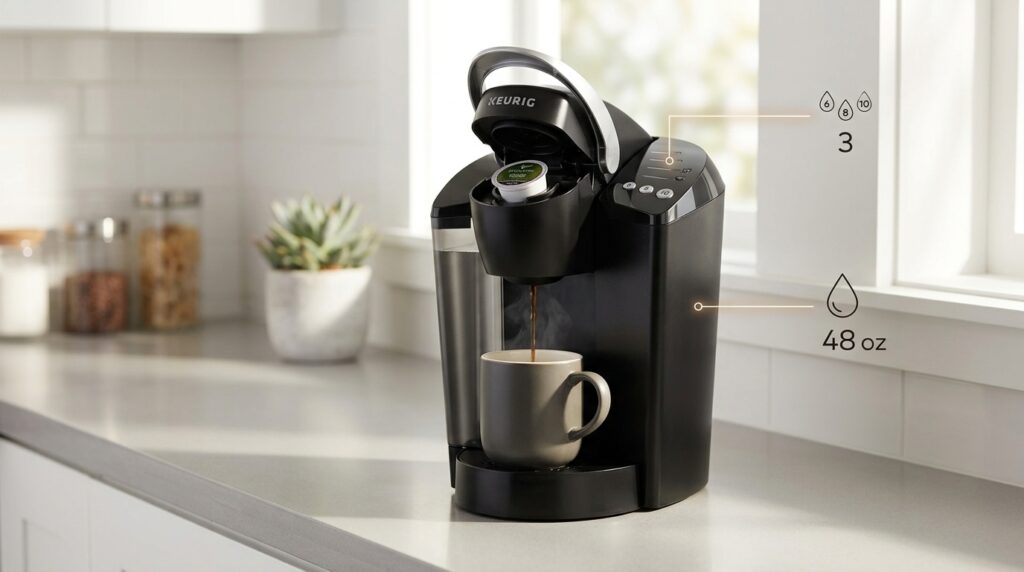
The reservoir serves as the water supply for the brewer. At 48 ounces, this capacity sits in the middle range for single-serve brewers. To put that in perspective, 48 ounces equals three 16-ounce cups of water. Depending on your brew size selection, this could mean roughly three to four cups of brewed coffee before you need to refill.
The removable design means you can take the reservoir to your sink or water pitcher rather than pouring water directly into the machine. Many people find this more convenient than machines with integrated, non-removable water tanks. You can fill it when the machine is off, making the process feel less rushed than trying to pour water into a running appliance.
The reservoir sits clearly visible in the back, so you can quickly gauge how much water remains. This transparency helps prevent the frustration of assuming you have water when the reservoir is actually empty.
Three Brew Sizes
The K-Classic offers three brewing options: 6 ounces, 8 ounces, and 10 ounces. These sizes cater to different cup preferences and drinking occasions. The smallest size works well for espresso-style cups or anyone who prefers a very concentrated coffee. The medium option suits standard coffee mugs. The largest size appeals to those who like a more generous serving or prefer a lighter strength coffee by diluting the same amount of grounds with more water.
You select your desired size before brewing using buttons on the machine’s control panel. The brewer automatically adjusts water flow and brewing time accordingly. This means the same K-Cup produces noticeably different results based on which size you select—a practical feature for households with varying preferences.
Heating System
The K-Classic uses a rapid heating technology that reaches brewing temperature quickly. Most users report that the machine can brew within two to three minutes of powering on, though the exact timing depends on water temperature and environmental factors. This speed matters when you’re running late or simply don’t want to wait long for your morning coffee.
The heating system maintains consistent temperatures across brew cycles, which contributes to reliable flavor from one cup to the next. Temperature stability helps extract coffee properly—too cool and the coffee tastes weak and underdeveloped; too hot and it becomes bitter.
Automatic Shut-Off
To address energy concerns, the K-Classic includes an automatic shut-off feature. The machine powers down after a period of inactivity, typically 30 minutes. This prevents the device from running indefinitely if someone forgets to manually turn it off.
Compact, Functional Design
The K-Classic comes in black and occupies a relatively modest footprint on a countertop. Its dimensions make it suitable for smaller kitchens or spaces where counter real estate is limited. The straightforward design lacks elaborate curves, LED displays, or ornamental elements—it’s utilitarian in appearance, which some appreciate for its no-nonsense aesthetic.
How the K-Classic Fits Into Daily Life
Morning Routine Integration
For many households, the K-Classic represents a faster alternative to traditional drip coffee makers or pour-over methods. If your morning involves multiple people wanting coffee at different times, the single-serve format allows each person to brew exactly what they want without waiting for a full pot or having to drink lukewarm coffee that’s been sitting for twenty minutes.
Parent with a teenager who drinks coffee differently than you do? Both of you can have your preferences accommodated within minutes. The simplicity also means family members who aren’t seasoned coffee drinkers can operate the machine without instruction or supervision.
Office and Workspace Scenarios
Though designed for home use, some small offices or break rooms use single-serve brewers like the K-Classic because they reduce waste from abandoned full pots and eliminate the social dynamics of “who makes the next pot?” Everyone makes their own cup on demand.
Guest Accommodation
When visitors arrive, you can offer fresh coffee tailored to their preferences. Do they prefer a smaller, stronger cup or a larger, milder one? The three size options provide flexibility without requiring you to ask complicated questions or compromise your own preferences.
Different Beverages Beyond Coffee
While K-Cups are predominantly coffee, the pod ecosystem includes various options: single-origin coffees, flavored varieties, espresso, and other beverages. This diversity means the K-Classic isn’t limited to one type of drink, though coffee remains the primary use case.
Who May Find This Brewer Suitable
Busy Professionals and Families
If your morning involves coordinating multiple schedules, the speed and simplicity of pod-based brewing appeals to efficiency. No grinding, measuring, or waiting for a full pot to brew when you only need one cup.
Those With Limited Counter Space
Apartment dwellers, small home offices, or anyone where kitchen space is at a premium can appreciate the K-Classic’s compact design. It takes up considerably less room than many alternatives.
Inconsistent Coffee Drinkers
If coffee consumption in your household varies dramatically day to day—some mornings nobody drinks any, other mornings several people want multiple cups—the single-serve format avoids waste and the need to predict daily needs.
People Who Prefer Consistency
Some coffee lovers appreciate the standardized nature of K-Cup brewing. Each pod contains a predetermined amount of coffee grounds, eliminating variables related to measuring or grinding. This consistency appeals to those who want reliable, predictable results.
Those New to Coffee Brewing
If you’re just beginning to explore coffee beyond instant varieties, the K-Classic’s simplicity removes intimidation factors. There’s no learning curve regarding water temperature, brew time, or grind size. You insert a pod and press a button.
Multi-Person Households With Varying Preferences
Households where some people want dark roast, others prefer light roast, and perhaps someone enjoys flavored varieties benefit from the K-Cup format. Everyone can select exactly what they want without compromise or additional brewing.
Important Considerations and Realistic Expectations
Pod Availability and Cost
The K-Classic uses K-Cup pods, which are widely available through grocery stores, online retailers, and discount warehouse clubs. This availability is convenient but also important to understand: you’re somewhat dependent on an ongoing supply of pods. Unlike traditional drip brewers where you simply buy coffee beans or grounds and brew, the K-Classic requires purchasing compatible pods.
Over time, repeated pod purchases represent an ongoing expense. While a single pod might cost less than a specialty coffee shop visit, the cumulative cost compared to buying bulk coffee beans warrants consideration if cost consciousness is important to you.
Environmental Impact of Pods
Individually packaged pods create plastic waste. While this doesn’t affect how the machine functions, it’s worth acknowledging as part of the user experience. Some manufacturers have introduced recyclable or compostable pod options, but the standard plastic pods aren’t biodegradable and contribute to landfill waste. If environmental impact influences your purchasing decisions, this is a meaningful consideration.
Flavor Profile Differences
Single-serve pod brewing produces coffee that’s noticeably different from pour-over, French press, or espresso methods. The coffee is typically lighter and less complex than what specialty equipment produces, though whether this matters depends on your preferences. Many people find pod coffee completely satisfying; others miss the depth they get from other brewing methods.
The K-Cup format also creates a sealed environment during brewing, which some argue produces less optimal extraction than open brewing methods. This is a technical consideration that impacts final flavor, though it’s subtle enough that most casual coffee drinkers don’t consciously notice.
Maintenance Requirements
The K-Classic requires periodic cleaning to function optimally. The needle that punctures the K-Cup accumulates residue over time, and mineral deposits from water can build up inside the machine. Most manufacturers recommend running cleaning cycles with special descaling solutions every three to six months, depending on local water hardness.
Unlike fully automatic espresso machines, the K-Classic requires relatively minimal maintenance, but it’s not completely maintenance-free. Users who overlook cleaning protocols may experience slower brewing, clogged needles, or other issues that compromise performance.
Water Quality Matters
If your tap water is extremely hard or has significant mineral content, you may need to descale more frequently. Conversely, if you live where water is particularly soft, you might need to descale less often. Using filtered water can extend the time between cleaning cycles, though this represents an additional cost and step in your routine.
Brew Size Limitations
While three size options provide flexibility, they represent relatively standard servings. If you typically drink much larger cups or smaller espresso-style shots, the available sizes might not perfectly match your preference. The 10-ounce option represents the maximum single-serve capacity.
Noise Level
Single-serve brewers are generally louder than people might expect. The pump and heating mechanism produce noticeable sound during brewing. If you’re brewing while others are sleeping or in a very quiet environment, this is worth considering. It’s not deafening, but it’s definitely not silent.
Comparing Single-Serve Brewing Methods
The broader coffee maker landscape includes several approaches to single-serving. Understanding how pod-based brewing compares contextually helps clarify where the K-Classic fits within the bigger picture.
Pod-Based Systems (Like K-Cups)
Pod systems offer maximum convenience and minimal decision-making. Pod-based brewers appeal to people who prioritize speed and simplicity above all else. The trade-offs include limited customization, ongoing pod purchases, and environmental considerations related to individual packaging.
Traditional Drip Coffee Makers
A basic drip coffee maker brews a full pot—typically 8 to 12 cups—from loose grounds. This approach offers excellent value per cup and produces large quantities suitable for households where multiple people drink coffee simultaneously. The downside is that if you’re the only coffee drinker, you’ll waste most of the pot or spend time cleaning and storing unused coffee.
Pour-Over Methods
Manual pour-over brewing with a filter cone or pour-over device requires active participation but offers impressive flavor control. Enthusiasts appreciate the ability to adjust grind size, water temperature, and brewing time. However, this method takes longer and appeals to people who enjoy the ritual, not those prioritizing speed.
French Press
French press brewing produces rich, full-bodied coffee because the entire grounds stay in contact with hot water for several minutes. It requires more cleanup than pod or drip systems and doesn’t produce crystal-clear liquid (fine particles settle at the bottom). French press users tend to be coffee enthusiasts who value flavor depth and don’t mind the extra effort.
Espresso and Semi-Automatic Machines
Dedicated espresso machines create concentrated coffee by forcing pressurized hot water through finely ground coffee. These devices are expensive, require skill to operate, and demand significant maintenance. They appeal to people who regularly consume espresso-based beverages and want café-quality results at home.
Manual Coffee Makers (Aeropress, Moka Pot)
These devices occupy the middle ground between fully manual and fully automatic. They require more involvement than pressing a button but less than pour-over. They’re portable and durable but demand some learning and attention.
Where the K-Classic fits: It’s the convenience endpoint. If minimizing time, effort, and decision-making is your priority, it’s hard to beat. If you’re willing to invest time or money into optimizing flavor, other methods might satisfy you more.
Frequently Asked Questions
What are K-Cups made from, and can they be recycled?
Standard K-Cups are plastic pods containing ground coffee and a paper filter. Most K-Cups aren’t accepted by curbside recycling programs because they’re considered contaminated—the coffee grounds prevent them from being processed easily. However, some manufacturers offer recyclable or compostable alternatives. Check with your local waste management to see if they accept coffee pods specifically.
How does the K-Classic compare to other Keurig models?
Keurig manufactures numerous brewer models at different price points. Higher-end models often include programmable brewing, larger reservoir capacities, and additional customization options. The K-Classic represents a more basic offering—it prioritizes essential functionality and straightforward operation over advanced features. Whether this basic approach suits you depends on whether you actually want those extra features or consider them unnecessary complexity.
Can I use generic K-Cups from brands other than official Keurig pods?
Yes. While Keurig manufactures its own pods, numerous third-party companies produce compatible pods. These alternatives often cost less and include diverse coffee varieties. Many people regularly use non-Keurig brand pods without issues. Some early-generation Keurig brewers included technology to reject non-branded pods, but this has been phased out.
How often should I clean my K-Classic?
Manufacturers typically recommend running a cleaning cycle every three to six months using special descaling solutions. If you live in an area with hard water, monthly cleaning might be necessary. More frequent cleaning prevents mineral buildup that slows heating and reduces brew quality. Regular cleaning extends the machine’s operational lifespan.
What if my K-Classic isn’t brewing or brewing very slowly?
Slow or failed brewing usually indicates either an empty reservoir, a clogged needle, or mineral buildup inside the machine. First, verify your water level. Next, try running a cleaning cycle with descaling solution. If the problem persists, the needle puncturing the K-Cup might need manual cleaning—most manufacturers include instructions for safely clearing this component.
Is the K-Classic loud?
Single-serve brewers are generally louder than people initially expect because the heating mechanism and pump create noticeable sound. The K-Classic isn’t silent, though most users don’t consider it objectionably loud. If you brew early morning while household members sleep, the noise might be worth considering.
Can I use my own ground coffee instead of K-Cups?
Technically, you can purchase a reusable K-Cup filter basket and fill it with your own coffee grounds. This approach reduces pod waste and often costs less. However, it requires more effort than inserting a pre-packaged pod and involves cleaning the filter afterward. Some users embrace this hybrid approach; others find it defeats the purpose of owning a pod-based brewer.
What size cup or mug should I use?
The K-Classic brews directly into whatever cup or mug you place underneath. Any standard mug with an opening large enough to fit under the dispenser works fine. The actual cup size doesn’t matter—only how much brewed coffee you want, which is controlled by your size selection.
Does the K-Classic have a programmable start time?
No. The K-Classic lacks programmable or scheduled brewing features. You must manually turn on the machine and press brew each time. If automatic brewing on a schedule is important to you, higher-end Keurig models offer this capability.
Is hot water always available, or only after brewing?
The K-Classic doesn’t have a separate hot water dispenser. Hot water is only available as part of the normal brewing cycle through a K-Cup. If you need hot water for tea, instant oatmeal, or other uses, you’ll need to use a separate electric kettle or stove.
How long does the K-Classic last?
With proper maintenance, single-serve brewers typically function for several years. Some users report five to seven years of reliable use, while others experience issues sooner. Longevity depends on water quality, cleaning frequency, usage intensity, and manufacturing variations. Like any appliance, eventual breakdown is inevitable, but regular maintenance helps maximize the machine’s operational lifespan.
Can the K-Classic brew cold coffee or iced coffee?
The machine itself only brews hot coffee. However, you can brew a small-size cup of hot coffee into a glass filled with ice to create an iced coffee drink. The two-step process isn’t as seamless as dedicated iced coffee makers, but it’s certainly possible.
Conclusion
The Keurig K-Classic represents a particular approach to coffee making: prioritizing simplicity, speed, and convenience over complexity, customization, and cost optimization. It’s designed for people whose primary goal is quickly getting a fresh cup of coffee without extensive preparation, equipment knowledge, or decision-making.
This brewer excels in scenarios where different household members want different things simultaneously, where counter space is limited, or where consistency matters more than experimentation. It works well for those new to coffee brewing who want to avoid the intimidation factor of specialty equipment.
However, the K-Classic isn’t the right choice for everyone. Coffee enthusiasts who value flavor nuance might find pod-based coffee disappointing compared to specialty brewing methods. Budget-conscious households that drink coffee daily might prefer the lower per-cup cost of buying bulk grounds. People concerned about environmental impact will find the individual pod packaging troublesome.
The honest assessment is this: the K-Classic solves specific problems very well. If those problems match your actual needs and situation, it delivers genuine value. If you’re trying to force this machine into a use case it’s not designed for, you’ll likely feel disappointed.
Before making any decision, reflect on what matters most to you in a coffee maker. Speed? Flavor? Cost per cup? Environmental impact? Simplicity? The K-Classic can’t optimize for all of these simultaneously. Understanding your actual priorities clarifies whether this particular brewer deserves a place in your kitchen.